


I’ve been covering developments in Sudan since 2019 and have, in recent years, been writing repeatedly about the devastating war now tearing the country apart. For example, see here for a thorough background or here for the latest on the fall of the city of el-Fasher. I’ve also written about the cynical whataboutism that pits Sudan’s suffering against Gaza’s.
Since the war erupted in the spring of 2023, one recurring theme in my reporting has been the role of the United Arab Emirates, a key architect of Sudan’s agony. The emirate has flooded the paramilitary Rapid Support Forces (RSF) with money and weapons, many of which are imported from elsewhere. A militia that has made war crimes and genocide its hallmark. In the UAE, it has secured gold, fertile land, and an expanding regional influence.
Gold and Blood: The United Arab Emirates and the Sudanese Genocide

Over the past week, horrific images have emerged from Sudan, specifically from the western city of el-Fasher, which has just fallen to the paramilitary Rapid Support Forces (RSF). Mass executions, kidnappings, and rapes have fol…
With the RSF now controlling most of western Sudan and effectively splitting the country in two, it’s clearer than ever that this war will not end as long as the UAE remains its financial and logistical backbone. The international community must confront this fact and pressure the emirate to end its support.
That won’t be easy. The UAE is deeply entrenched in global finance, logistics, and trade. But governments must at least try. So far, though, the efforts have been minimal.
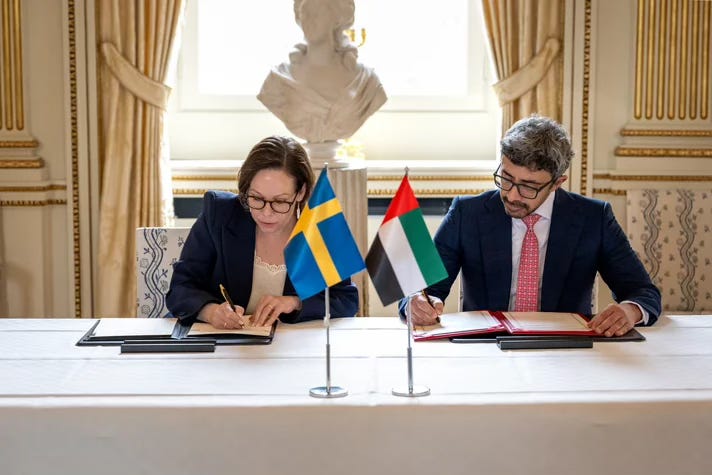
Take Sweden, for instance, the country where I live. Sweden maintains extensive and growing trade ties with the UAE, which has recently become the single largest importer of Swedish arms. This gives Sweden, and ideally the EU as a whole, some leverage – leverage that could be used to push the emirate toward ending its sponsorship of mass suffering.
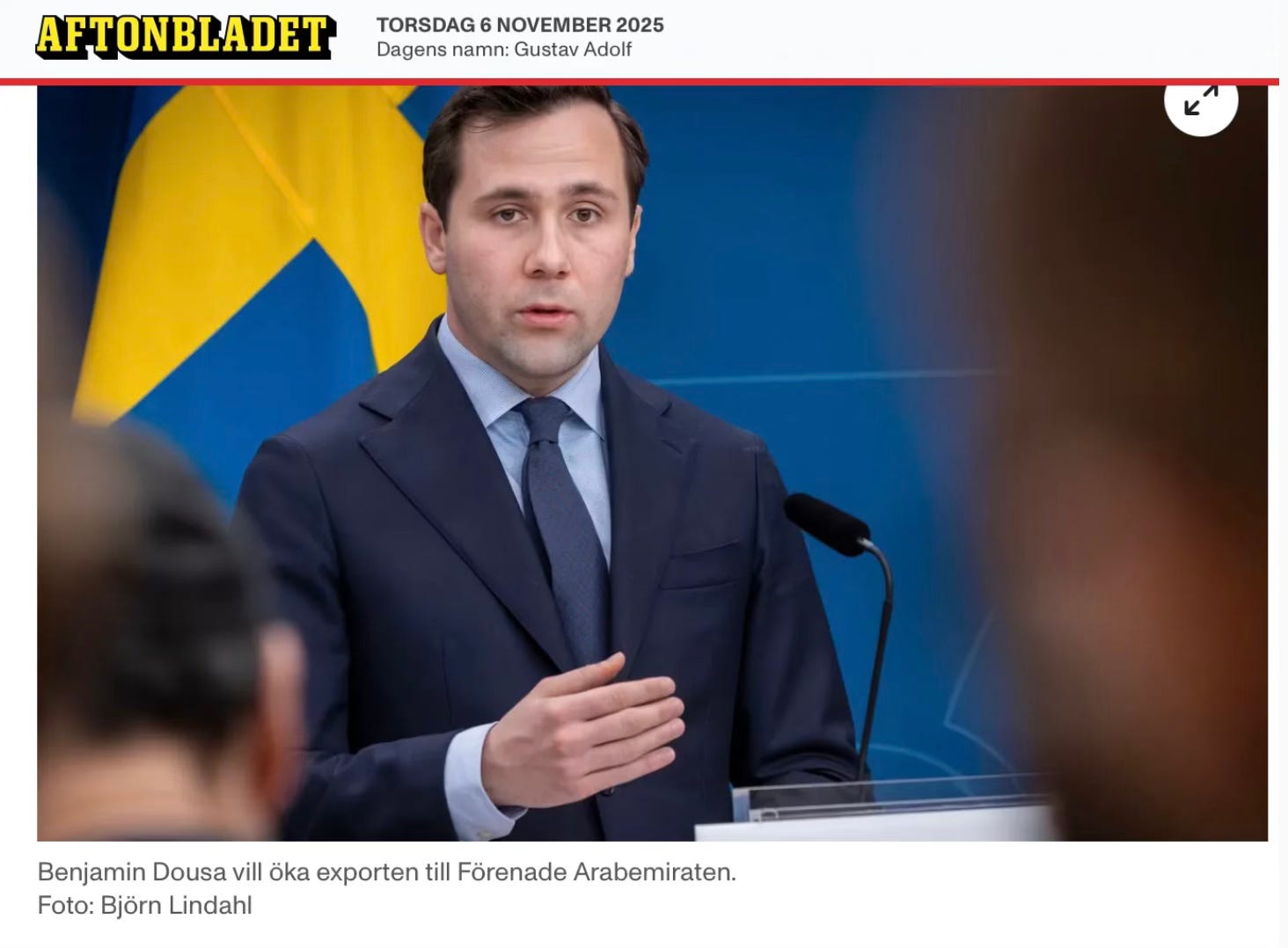
Instead, we get statements like the one made by Swedish Minister for Foreign Trade and International Development Cooperation Benjamin Dousa in Aftonbladet on November 4, 2025. When asked how Sweden justifies trading with a country sponsoring human suffering on an incomprehensible level, he replied:
“When the US looks inward and raises tariffs, we need to find other markets to export our goods and services to. It’s about Swedish jobs and tax revenue for healthcare, education, and social care. The United Arab Emirates is the largest export market for Sweden in the Middle East, with over 250 Swedish companies operating there. Trade and exchange also create a platform for dialogue. The alternative to trade is isolation, making it difficult to achieve constructive dialogue and political agreements. Now we can use this platform and our good relations to address, for example, the situation in Sudan.”
As if boycotts, isolation, or diplomatic pressure were untested tools. As if the only way to influence a foreign regime were to keep selling it weapons. As if Swedish jobs and welfare depended on enabling war crimes.
The following day, November 5, Foreign Minister Maria Malmer Stenergard posted the following video on her Instagram:
Stenergard asked herself why people weren’t taking to the streets to support the people of Sudan – a strange question coming from a government that has spent two years labeling pro-Palestine demonstrators as loudmouths, savages, and “terror sympathizers,” while moving to restrict the right to protest.
Again: a concrete, immediate step Sweden and the EU could take to help end the war would be to halt, or at least curtail, arms sales to the United Arab Emirates. But Stenergard rejects that idea too. In an interview on the public radio show Studio Ett, she argued:
“If you are going to insist on that reasoning, then we would stop all forms of trade to all countries that do not think exactly as we think. That would leave us quite isolated.”
It’s a breathtaking display of double standards. Unfortunately, Sweden shares this with many other governments around the world. They condemn the horrors unfolding in Sudan, yet when presented with a tangible way to try and stop them, their hands are suddenly tied.